What are the fire risks in switch cabinets?
From danger to life and limb to property damage and production downtime – when fires break out in electrical equipment, the risks and consequences are manifold. Despite ongoing developments and rising quality standards, electricity remains one of the top causes of fires. Analyses show that between 2002 and 2022, 32% of fires in Germany were caused by electricity, compared to 24% in Austria and 26.6% in Switzerland. The relevance of these figures is illustrated by insurance statistics such as the Global Claims Review 2022 (AGCS). In Germany, 37% of insurance claims by companies were attributable to fires and explosions, and in Austria the figure was 40%.
What are the requirements for fire suppression systems for switch cabinets?
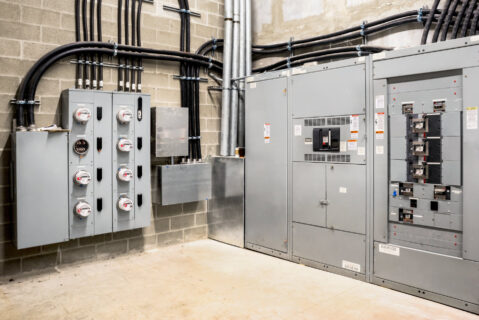
Switch cabinets are naturally designed to be very space-optimised. Extinguishing systems must be correspondingly small and easy to integrate. This requires a highly effective extinguishing agent that is stored directly in the switch cabinet.
Extinguishing agents that use water or foam are not suitable for switch cabinets. The damage caused by extinguishing would be catastrophic. A dry extinguishing agent is required that leaves no or no harmful residues. Aerosol extinguishing agents are suitable for this purpose, as they leave minimal residues but cause no damage and are easy to clean, or gaseous extinguishing agents, which leave no residues at all but place significantly higher demands on the switch cabinet.
Depending on the protection objective, cost-effective stand-alone systems or controlled variants can be used. The advantage of the latter is that smoke or CO detectors, for example, can be used to detect smouldering fires and combat them in their early stages. An alarm can also be sent to higher-level fire alarm systems to signal a trigger in a control cabinet.
degesa fire systems uses only environmentally friendly extinguishing agents. After activation, they can simply be vented into the atmosphere.
degesa fire systems uses only non-toxic extinguishing agents. Thanks to continuous development, there is no longer any reason to use toxic extinguishing agents.
Installation of a switch cabinet fire suppression system
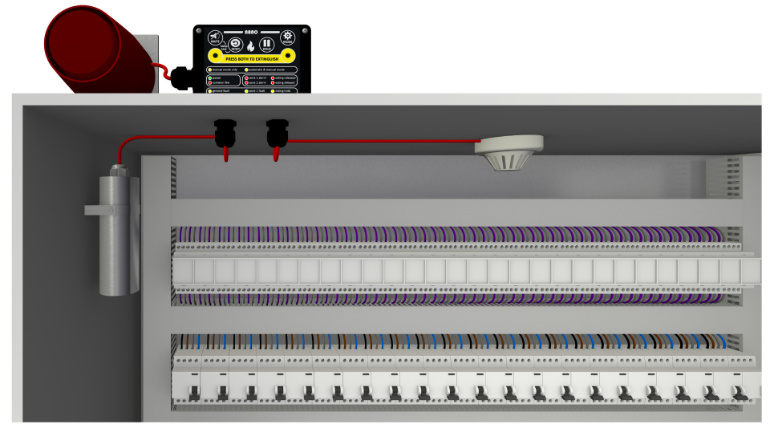
Visual/audible signal transmitter
An optical/acoustic combination signal transmitter signals the triggering directly at the control cabinet.
Fire alarm and extinguishing control centre
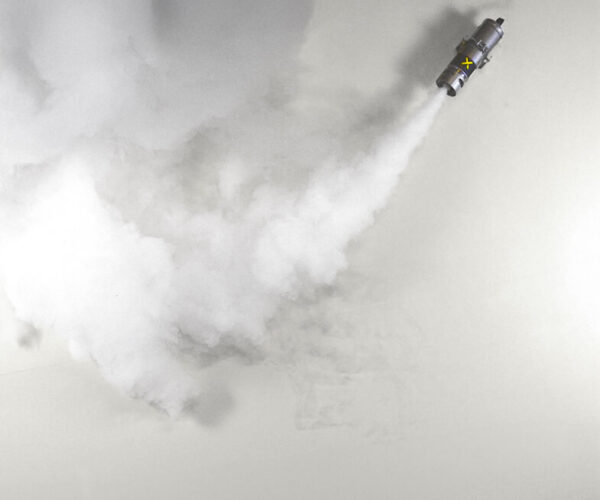
aerosol extinguishing generator
The aerosol extinguishing generators are mounted directly in the control cabinet. The extinguishing agent is already contained in the extinguishing generator in the form of a solid compound and is generated in an internal reaction upon activation. The aerosol extinguishing generators are not pressurised and can be mounted flexibly in the control cabinet. No bottles, pipes, nozzles or pressure measuring systems are required, and normal leaks such as ventilation slots or cable ducts can be easily compensated for.
Automatic detectors
Automatic detectors, such as smoke or CO detectors, monitor the switch cabinet 24/7 and detect fires as soon as they start. To avoid false alarms, several detectors can be used – for example, at least two detectors must be activated before an alarm is triggered.
How does a switch cabinet fire suppression system work?
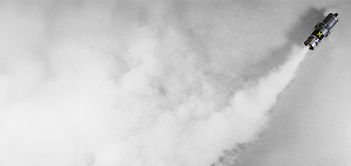
Fire suppression systems flood the control cabinet with a highly effective extinguishing aerosol that interrupts the combustion reaction of the fire. The free radicals in the flame can no longer react with oxygen due to the extinguishing agent, so that the fire is extinguished within a few seconds – without displacing oxygen or inerting the cabinet.
The aerosol remains in the control cabinet for a long period of time, providing excellent post-fire safety. It is much easier to handle than gaseous extinguishing agents, as it is not discharged under pressure and control cabinets do not have to be completely sealed.