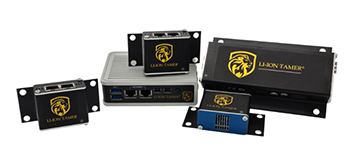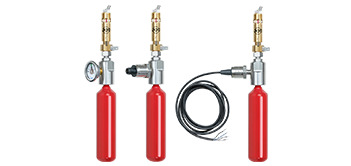
How does the Li-ion Tamer work?
Conventional detection methods such as smoke extraction systems or smoke detectors can only issue an alarm at the moment of thermal runaway, as smoke development in lithium-ion batteries only begins when heat builds up and the battery chemistry decomposes. An alarm is therefore only emitted at a point where the temperature has already risen to such an extent that ignition and thermal runaway are highly likely.
However, small amounts of gas are released several minutes before the temperature of the battery cell is high enough to cause smoke to develop. The gas mixture is primarily produced by the decomposition of the electrolyte material and depends on the electrolyte material used and the state of charge of the cell. For this reason, “outgassing” cannot be reliably detected with conventional gas detectors. The Li-ion Tamer is the only system of its kind and is specially designed for the gases that can be produced by lithium-ion batteries.
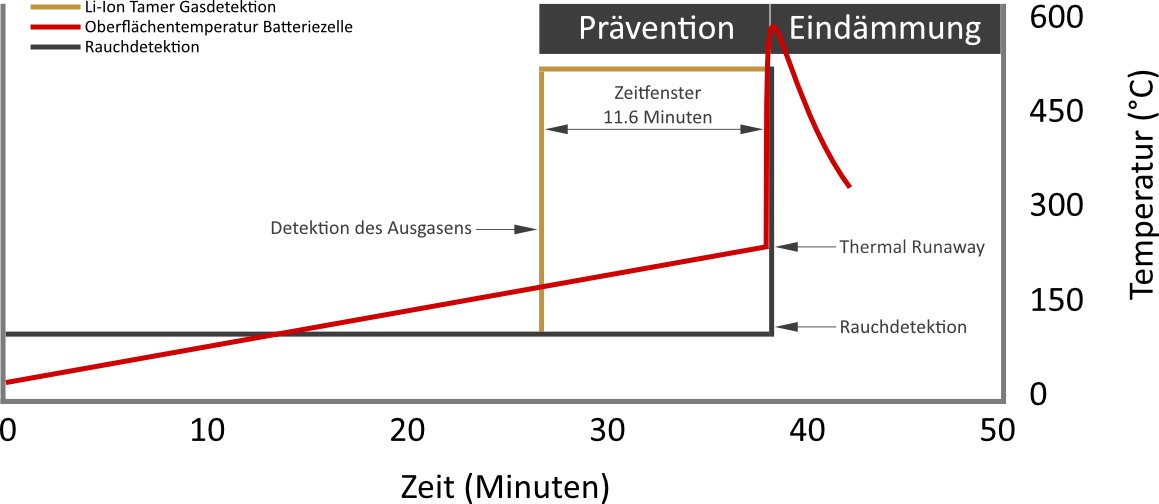
Comparison of detection methods
Working principle of the Li-ion Tamer
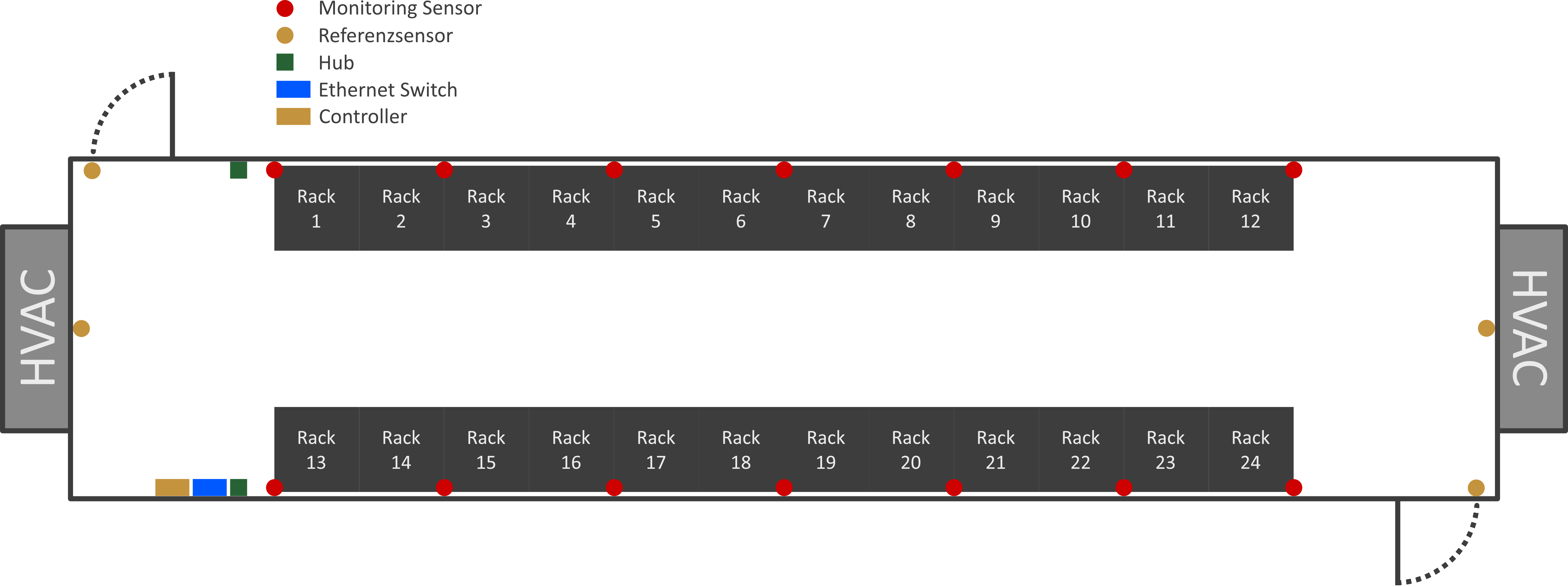
A Li-ion Tamer GEN3 system is a highly flexible solution for lithium-ion batteries. The system typically consists of:
- Monitoring sensors that are mounted close to the respective batteries, usually directly in the upper part of the module rack.
- Reference sensors to prevent false positive alarms. The system does not require calibration.
- Hubs and Ethernet switches to combine the individual signals
- Controller to evaluate data and control other systems
The Li-ion Tamer GEN3 system requires minimal operation and maintenance and has a comparable service life to a battery storage system. The response of the gas sensors and the correct activation of preventive measures can be checked with a simple test.
Important
The Li-ion Tamer detects the escape of electrolyte vapours from lithium-ion batteries and can trigger appropriate prevention and/or containment measures. It therefore only indirectly prevents fires and thermal runaway and does not constitute an independent safety device.
Technical specifications
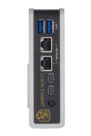
Li-ion Tamer Controller
The Li-ion Tamer Controller is an industrial computer that aggregates, processes, and communicates the signals from the sensors. The sensor data is timestamped and recorded and is thus available for later diagnosis after events. One controller can process up to 100 sensors.
Communication can occur via Modbus TCP/IP or relays, so there are no limits to integration and activation of existing systems.
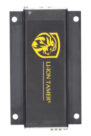
Li-ion Tamer Hub
The daisy-chain connection of the sensors for power distribution and CAN bus communication begins at the Li-ion Tamer Hub. Each hub can manage up to twelve sensors.
The Li-ion Tamer Hubs are available both with direct power supply and as a Power-over-Ethernet variant. Especially larger systems can thus be monitored with little installation effort.
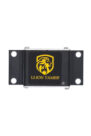
Li-ion Tamer Sensor
The Li-ion Tamer sensors are divided into monitoring sensors and reference sensors. The monitoring sensors serve to detect electrolyte and solvent vapors and are installed in the exhaust air flow of the respective battery racks or modules. The reference sensors are strategically mounted near entry points of external pollutants to avoid false-positive alarms.
Innovative 360° fire protection concept for lithium-ion batteries
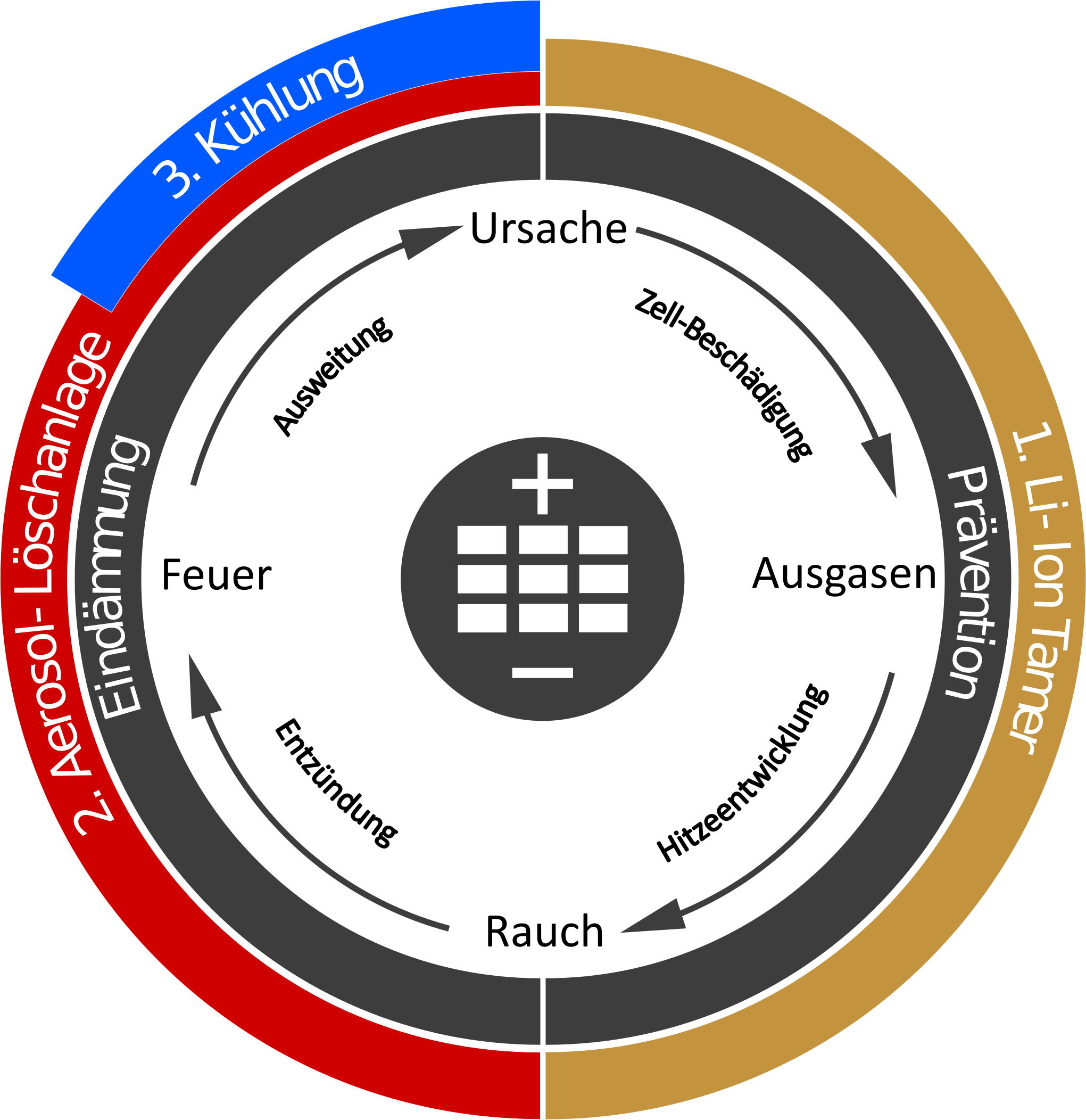
degesa fire systems follows a three-stage approach in fire protection for lithium-ion batteries. The Li-ion Tamer is used as a critical first of three stages.